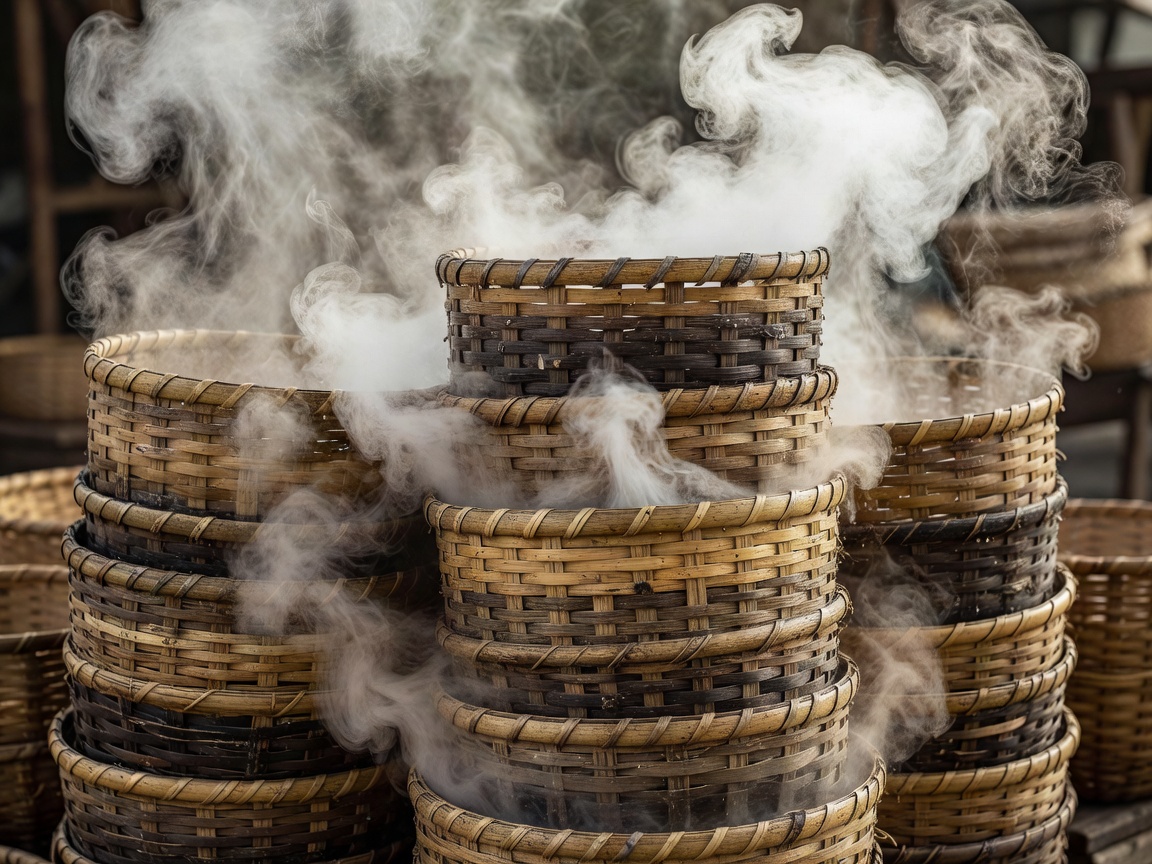
The Condensation Catastrophe
The primary enemy of a delicate steamed dumpling is not under-steaming, but condensation rain. When water vapor rises in an impermeable stainless steel or glass lid, it hits a cooler surface, condenses into heavy liquid droplets, and drips directly back onto the dumplings below, turning the wrapper soggy and deflating the shape.
Why Woven Bamboo Outperforms Metal
For over two millennia across Southern China and East Asia, the Zheng Long (woven bamboo steamer basket) solved this thermodynamic dilemma with biological elegance:
- Capillary Absorption: Natural bamboo fibers absorb excess steam moisture within the porous cellulose matrix, completely preventing condensation droplets from forming overhead.
- Micro-Venting Lattice: The domed, hand-woven bamboo lid acts as a natural pressure regulator, allowing excess vapor to escape while maintaining an internal temperature between 98°C and 100°C.
- Woody Aroma Infusion: As the bamboo heats, it releases subtle terpene compounds that perfume the dough with a fresh, grassy tea-like fragrance impossible to replicate in steel.
"A master bamboo cooper bends the outer cedar or pine rings using boiling water, pinning the layered bark with spruce roots rather than metal nails to allow the wood to expand and contract harmoniously with heat cycles."
Stacking Physics & Thermal Gradient
Commercial dim sum operations stack bamboo baskets up to 10 tiers high above a single wok boiler. Because steam naturally cools as it ascends, dense meat dumplings (like pork Shumai) are placed in the lower tiers closest to the boiling water, while delicate translucent starch dumplings (like Har Gow) reside in the upper tiers where steam velocity is gentler.